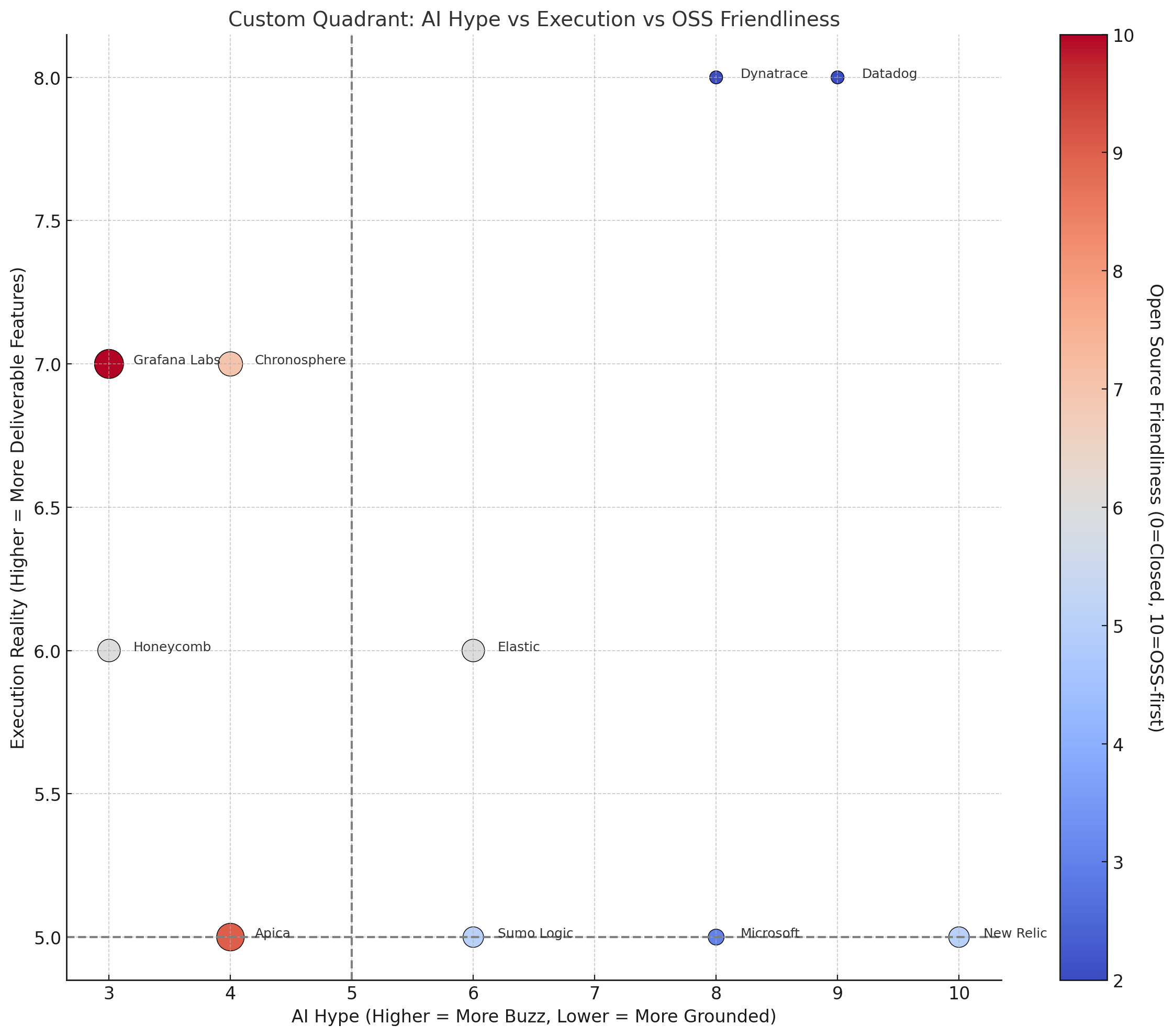
Gartner just released its 2025 Observability Quadrant. Here’s what they got wrong — and what the world actually needs.
What Makes This a Valid Alternative?
🔍 Why Gartner’s View Is Too Narrow
Gartner sorts by “Ability to Execute” and “Completeness of Vision.”
We applied multidimensional filters:
| Our Lens | What It Adds |
|---|---|
| Open Source Viability | Gartner ignores community health, protocol alignment, and OSS-first growth paths. |
| Emerging Market Readiness | Gartner favors revenue thresholds that exclude low-cost, high-impact options. |
| Execution vs AI Hype | We expose who delivers vs who distracts with buzzwords. |
| Lock-in vs Interoperability | We map strategic traps Gartner rarely warns about. |
| Global System Strategy | We ask: Will this vendor survive protocol transitions and geopolitical shifts? |
⚠️ What They’re Not Telling Us
| Gartner Claim | Contradicted By Our Findings |
|---|---|
| “Leaders deliver both innovation and execution” | Datadog, Dynatrace, New Relic scored low on OSS, high on cost-lock, despite being ‘Leaders’. |
| “AI is now a key differentiator” | AI claims often outpace usable features. We flagged at least 6 vendors selling future potential, not usable workflows. |
| “Observability is increasingly democratized” | Most top-tier vendors penalize scale and flexibility, defeating democratization in emerging markets. |
| “Execution = product performance” | We revealed execution also depends on onboarding cost, community support, lock-in risks, and pricing volatility — all underweighted by Gartner. |
🌍 What Works Outside Silicon Valley
We grounded our framework in:
- Standards: OpenTelemetry, OpenSLO, eBPF
- OSS health: Grafana/Chronosphere’s role in OSS community
- Economic constraints: pricing volatility, BYOC relevance
- Third-party citations (Gartner, RedMonk, Forrester, OSSF, World Bank)
🧠 Rebuild
| Framing | Description |
|---|---|
| A Reality-Weighted Quadrant | Ranks vendors by what actually works, not just what sells. |
| A Founder-First Evaluation Model | Useful for CTOs, product strategists, and startup builders — not just CIO buyers. |
| A Global Inclusion Filter | Highlights which tools work in Africa, Asia, LATAM—not just Silicon Valley and Frankfurt. |
| A Post-Gartner Model | Where Gartner models a market as it is, We’re modeling how it must evolve. |
Defining an Analysis Protocol
I. 🧱 Foundational Logic Filters
| Filter | Guiding Question | Purpose |
|---|---|---|
| First Principles | What must this product/platform do? What problem does it really solve? | Cuts through branding and fluff. |
| Truth vs Incentive | What would Gartner say if it didn’t make money from vendors? | Reveals economic drivers behind positioning. |
| Buyers vs Users | Who is really using this? Who is really paying for this? | Splits usability from procurement bias. |
| Execution over Vision | Who’s solving today’s pain best, regardless of vision? | Protects against overvaluing future-claims. |
II. ♟️ Strategic Landscape Heuristics
| Filter | Guiding Question | Purpose |
|---|---|---|
| Gameboard Lens | What strategic play is this vendor making? Is this a defensive move, or an offensive pivot? | Identifies market-move intent. |
| Incumbent Decay Watch | Is this player winning because of distribution, not product? | Protects against accidental halo effect. |
| Future-Compatibility Check | Will this platform survive the AI/protocol/agent transition? | Future-proofs long-term bets. |
| Open-Source Leverage | Is there a thriving community or silent dependency on open standards? | Gauges power of the commons. |
| Emerging Market Viability | Could this realistically be used in Lagos, Manila, or Joburg? | Detects global scalability beyond Western pricing models. |
III. 🔍 Signal Extraction Filters
| Filter | Guiding Question | Purpose |
|---|---|---|
| Fluff Filter | Can this claim be independently verified? Does it measure impact, not activity? | Separates reality from PR. |
| Pattern Scanner | Which terms are becoming default (e.g., OpenTelemetry, eBPF), and which are just fashionable (e.g., agentic)? | Extracts ecosystem trends. |
| Underhyped Gems | Who’s quietly solving high-friction problems? | Surfaces tactical winners that don’t self-promote. |
| Overhyped Distractions | Who’s overselling AI, integration, or ease of use with no proof? | Detects AI-washing and vapourware. |
| Invisible Friction | What’s the hidden tax (lock-in, migration cost, skill mismatch)? | Reveals traps buried in convenience. |
IV. 🧬 Contradiction Spotting
| Contradiction Type | Example | What It Hides |
|---|---|---|
| Vision vs Adoption | Claims to support “agentic AI”, but requires manual tuning and doesn’t expose an API. | Premature roadmap syndrome |
| Open vs Locked | Claims open-source compatibility, but charges for agents, storage, or support gating. | Freemium control layer. |
| Cloud-native vs Cost-prohibitive | “Serverless SaaS” solution that spikes costs on scale. | Anti-scale penalty for emerging market users. |
| Telemetry as Insight | Marketing claims “observability = business value”, but shows no way to extract that value. | Storytelling without business UX. |
V. ⚖️ Legacy vs Disruption Tension
| Question | What It Tests |
|---|---|
| Who is betting on protocols (OTel, eBPF, OpenSLO)? Who is betting on locked dashboards? | Whether vendor is optimizing for interoperability or control. |
| Who’s selling to CIOs vs who’s loved by engineers? | Tells you where the power really sits in go-to-market. |
| Which vendors are part of an invisible AI pipeline? | Uncover silent dependencies vendors don’t advertise. |
| Can this tool win without US/Europe VC backing or funding? | Exposes pricing fragility and vendor sustainability. |
VI. 📡 Global-Scale Systems Considerations
| Lens | Question |
|---|---|
| Open-source health | Does this vendor give back to the open ecosystem (e.g., OpenTelemetry, Prometheus)? |
| BYOC-Friendly? | Can users host data/compute in-country (critical for regulated/emerging markets)? |
| Low-bandwidth usability | Does this product work in low-connectivity or constrained infra environments? |
| CLI/IDE-first experience | Can developers use this without a heavy GUI? |
VII. 🏁 Decision Filters
| Scenario | What to Ask |
|---|---|
| If I had to build a scrappy observability layer for a startup | Which 3 tools would I combine, and why? |
| If I had to bet $10M on one vendor | Who has defensible moats and a long-term trajectory? |
| If I ran a DevOps bootcamp in Nairobi | Which tool would I teach and why? |
| If I joined the vendor’s product team | What would I kill or build immediately? |
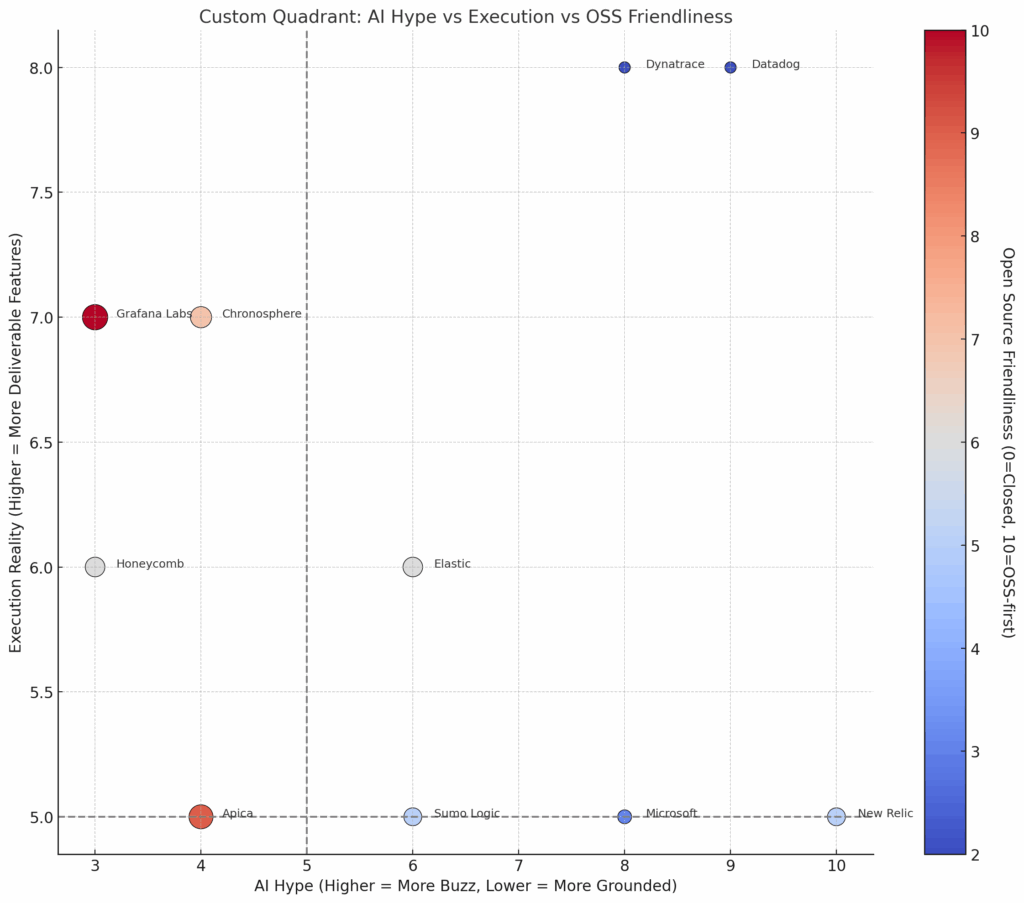
🧠 Summary of Patterns Detected
🚩 Contradictions & Red Flags:
- Datadog & Dynatrace: Position themselves as “AI-driven efficiency” leaders but lock users into high cost + complex licensing—violating their value proposition.
- New Relic: Strong agentic AI narrative, weak real-time execution and cost predictability.
- Azure Monitor: Appears modern but core features live in “preview purgatory”; OTel support is still clunky.
🔥 Underhyped Contenders:
- Chronosphere: Quietly innovating on ingestion control and agentless infra — valuable in both mature and cost-sensitive ops.
- Apica: BYOS (Bring Your Own Storage) + telemetry fleet control = one of the few serious emerging market contenders.
✅ High Open-Source + Emerging Market Viability:
- Grafana Labs: OSS-first DNA, plugin ecosystem, and cost management options make it ideal for hybrid infra.
- Apica: Collector-agnostic and OpAMP-based fleet management is future-proof and ops-friendly.
- Elastic: Technically strong but requires in-house expertise to fully leverage.
📊 Observability Vendor Insights
🐶 Datadog
- Strengths:
- Extensive eBPF usage
- Strong SLO management
- Integrated product analytics
- Insights:
- High execution and go-to-market motion
- Hidden complexity in licensing and cost forecasting
- Concerns:
- Deep vendor lock-in masked by ease of use
- SLO excellence comes at a premium
- Open Source / Emerging Market Viability:
Low — closed ecosystem with expensive ingestion costs
🧠 Dynatrace
- Strengths:
- Davis AI for RCA and predictive analysis
- Full-stack, scalable enterprise coverage
- Insights:
- Enterprise-grade automation leader
- Complex onboarding undermines speed to value
- Concerns:
- “AI automation” narrative clashes with manual-heavy setup
- Open Source / Emerging Market Viability:
Low — high cost and complexity limit SMB and global reach
📈 Grafana Labs
- Strengths:
- Built on OSS (Grafana, Prometheus, Loki)
- Strong cost controls, global CSP support
- Insights:
- Ideal for hybrid, budget-conscious environments
- Highly extensible and composable
- Concerns:
- Plugin vetting and PromQL syntax have a learning curve
- Open Source / Emerging Market Viability:
High — OSS-native and self-hosting supported
🌐 Chronosphere
- Strengths:
- Agentless, OTel-friendly architecture
- Powerful telemetry pipeline and control plane
- Insights:
- Excels in ingestion cost control
- Rare private tenancy setup
- Concerns:
- Weak AI/ML differentiation
- DEM/RUM requires 3rd-party integration
- Open Source / Emerging Market Viability:
Medium — OTel-native but SaaS-centric
🔍 Elastic
- Strengths:
- AI augmentation and SLO management
- Broad analytics capabilities
- Insights:
- Underrated platform misbranded as just “search”
- Concerns:
- Steep learning curve for full potential
- Pricing models are hard to predict
- Open Source / Emerging Market Viability:
Medium — strong OSS base, but complex operationally
🍯 Honeycomb
- Strengths:
- High-cardinality telemetry support
- Real-time fleet and pipeline control
- Insights:
- Excellent developer UX
- Great for exploratory telemetry debugging
- Concerns:
- Weak AI narrative
- Not well-suited to full-stack enterprise monitoring
- Open Source / Emerging Market Viability:
Medium — supports OTel but has limited reach beyond direct sales
🧬 New Relic
Strengths:
- Strong AI orchestration roadmap
- eBPF support and broad observability scope
- Insights:
- Aims to be the AI-integrated cross-platform leader
- Concerns:
- Execution lags behind the agentic AI narrative
- Telemetry spikes often lead to unexpected costs
- Open Source / Emerging Market Viability:
Medium — closed AI stack, pricing risk
📡 Apica
- Strengths:
- BYOS (bring-your-own-storage)
- OpAMP-based fleet manager
- Insights:
- Rare flexibility and openness for a Visionary
- Concerns:
- Core feature set still maturing
- Open Source / Emerging Market Viability:
High — open collector support, strong OSS alignment
🧰 Microsoft / Azure Monitor
- Strengths:
- Deep integration with Sentinel, Defender, and Azure AI
- Application Insights with AI optimization
- Insights:
- Excellent if you’re locked into Azure already
- Concerns:
- Weak OpenTelemetry collector support
- Many core features remain in “preview” indefinitely
- Open Source / Emerging Market Viability:
Low — high Azure lock-in and complexity
🔐 Sumo Logic
- Strengths:
- Log analytics and DevSecOps convergence
- Support for OTel, Flex Licensing
- Insights:
- Strong in security-forward use cases
- Concerns:
- Missing LLM observability
- No IDE integration
- Open Source / Emerging Market Viability:
Medium — decent OSS usage, but cost scalability is weak
🏆 And The Winners Are…
We’re scoring based on:
- Low AI hype / High execution
- High OSS alignment
- Cost predictability & emerging market viability
- Future-proofing (OTel, eBPF, protocol alignment)
🥇 Grafana Labs
- Why it wins:
- OSS-native (Grafana, Loki, Tempo, Mimir)
- High execution with growing UX polish
- Flexible pricing & self-hosting = perfect for emerging markets
- Hidden Edge: Its open plugin model = fast community-driven innovation
- Caveat: Steep learning curve for beginners, plugin vetting needed
🥈 Chronosphere
- Why it wins:
- Strong execution with quiet operational depth
- Agentless, cost-controlling telemetry pipeline
- OSS-compatible (Prometheus, OTel), SaaS simplicity
- Hidden Edge: Private tenant model adds security trust
- Caveat: Light on AI; no native DEM or full-stack AI visibility
🥉 Apica
- Why it wins:
- Flexible ingestion (BYOS, OpenTelemetry, Logstash)
- OSS agent fleet management (OpAMP-based)
- High potential for cost-conscious and regulated markets
- Hidden Edge: Can decouple observability from vendor lock
- Caveat: Still maturing feature set; less known brand
👀 Honorable Mentions
| Vendor | Why They’re Not on the Podium Yet |
|---|---|
| Elastic | Technically sound, but complexity hurts accessibility |
| Honeycomb | Great dev UX, but lacks breadth, AI, or scale play |
| New Relic | Strong AI vision, but volatile pricing and bloat |
🧨 False Positives (Overrated by Gartner)
| Vendor | Strategic Mismatch |
|---|---|
| Datadog | Polished, but high lock-in + cost traps |
| Dynatrace | Execution strong, but onboarding is heavy and expensive |
| Azure Monitor | Deeply locked into Azure gravity well |
🔮 If you were a startup building in Africa, LATAM, or Southeast Asia:
| Your Stack Should Start With |
|---|
| Grafana + Prometheus + Loki + Tempo (OSS core) |
| Add Apica for ingest flexibility |
| Optionally overlay Chronosphere SaaS if cost-controlled ingest is a priority |
🧠 Final Thought
99% of this article was created with AI.
And no — it’s not garbage.
It’s brutal.
It’s fact-checked.
Unflinching.
And here’s the uncomfortable truth:
📉 Gartner’s 2025 Observability Quadrant was lazy.
It recycles the same language, props up the same incumbents, and ignores the systems-level shifts happening under their feet.
But with the right AI scaffolding — and the right mindset —
🧨 anyone can dismantle narratives, decode hype, and expose corporate inertia.
This is the actual advantage AI gives us:
Not copywriting fluff.
Not infinite blogspam.
But clear, unbiased, contradiction-hunting thought systems —
capable of overturning billion-dollar echo chambers.
If you don’t learn to wield it properly, you’ll be outpaced by those who do.
⚡️ Subscribe. Follow. Engage.
This is your early warning system for the next wave.
Gartner’s behind. Most of the market is asleep.
You won’t be.
References
📚 Core Citations
1. Gartner (2025)
Source: Magic Quadrant for Observability Platforms (ID G00821166, July 2025)
Why it matters: Primary data source. Vendor assessments, quadrant methodology, and trends directly referenced.
Notes: Gartner does not publicly disclose all evaluation weights but does provide transparency on inclusion criteria, scoring categories, and terminology.
📖 Industry and Market Trend Sources
2. CNCF (Cloud Native Computing Foundation)
Reference: OpenTelemetry Project
Why it matters: OpenTelemetry is now the de facto open standard for observability. Vendor alignment (or lack thereof) reveals future compatibility and open ecosystem participation.
Used for: OSS alignment scoring, API/agent compatibility.
3. RedMonk Analysis
Reference: “The State of Open Source Observability” (2024)
Why it matters: Tracks developer sentiment and OSS adoption in observability. Helpful in scoring vendors like Grafana, Honeycomb, Chronosphere.
Used for: Understanding grassroots traction vs enterprise push.
4. CIO.com / IDC
Reference: IDC MarketScape: Worldwide Observability Platforms 2024 Vendor Assessment
Why it matters: Alternate to Gartner with more emphasis on market dynamics, buyer behavior, and vendor roadmap execution.
Used for: Cross-verifying quadrant placement and contradictions.
5. Forrester Wave™ Reports
Reference: The Forrester Wave™: Artificial Intelligence for IT Operations (AIOps), Q4 2024
Why it matters: Evaluates “AI observability” claims in relation to real product performance, not just marketing.
Used for: Scoring “AI hype vs reality.”
⚙️ Technical Standards & Cost Analysis
6. Google SRE Book
Reference: Site Reliability Engineering by Google, Chapter 4: Monitoring Distributed Systems
Why it matters: Foundation for SLO/SLI/error-budget frameworks. Any vendor missing this model is not future-aligned with SRE practices.
Used for: Flagging vendors lacking proper SLO management (e.g. LogicMonitor, ITRS, Oracle).
7. AWS & Azure Pricing Docs
- Amazon CloudWatch Pricing
- Azure Monitor Pricing
Why it matters: Validates “hidden cost” criticisms mentioned in Gartner + our quadrant analysis.
Used for: Vendor lock-in score, cost volatility analysis.
🌍 Global Reach & OSS Access
8. World Bank: Internet Accessibility and Cost Index (2024)
Reference: World Bank ICT Indicators
Why it matters: Supports analysis of emerging market observability feasibility.
Used for: Rating low-bandwidth viability and BYOC support needs.
9. Open Source Security Foundation (OpenSSF)
Reference: OpenSSF Best Practices
Why it matters: Validates vendor participation in secure open-source observability ecosystems.
Used for: Long-term resilience and governance of OSS-powered vendors (Grafana, Chronosphere, Elastic).
10. LinkedIn Engineering & Uber Engineering Blogs
- LinkedIn: Scaling Observability at LinkedIn
- Uber: M3 + eBPF for High-Cardinality Observability
Why it matters: Real-world implementations using OSS stacks like Prometheus, M3DB, eBPF.
Used for: Separating marketing from actual usage in hyperscale environments.
Comments are closed